The Practice Notebook

flutist Zara Lawler shares tips on learning music

Memorization Question

October25

In August of this year, I gave a lecture on my memorization technique.  A few weeks later I received this question from one of the attendees, Janel Caine, a private flute teacher, freelance performer, and founding member of Category 5 (Woodwind Quintet) in Tallahassee, FL.

What does one do when the number of notes is too many to say at a given tempo?  (Such as a run of 32nds?  Or even sextuplets that are easy enough to play, just difficult to speak out with a metronome?)

I thought the answer might be of general interest, so here it is:

Keep in mind that you do not have to say the note names aloud, you just have to think them, and thinking is usually much faster than speaking!  Then, if you are working on a really long string of lots of lots of fast notes (like say, the opening of Daphnis, though why you would memorize that I don’t know!), you can start thinking in a kind of short-hand once you get up to a prohibitive tempo for thinking all the note names.  For example, “then up a B-flat major scale to an F,” or “D Maj 7 chord” or some such.  For me, it feels kind of like the difference between reading whole words and reading by sounding out each letter.  The better and better you know your music, the more like words it will seem, and the less necessary to think of each individual note.  

I will say, though, that the more I work this way, the more note names I can hold in my head.  You may find that ability growing as you go!

Good luck!

-z

If you were at my lecture at the Convention, and did not get a copy of the handout, you can download one here.

PS.  Don’t you think Category 5 is a great game for a woodwind quintet based in Florida?

Memorizing a Whole Program

February4

Recently, I received a question from a reader about memorizing a whole program.  (You can read his question at the bottom of this post).  He is learning 17 songs. He noted that it was not possible to cover each every day, and asked about how to learn so many pieces at once, and more generally, how to prepare for the act of performing them all on one concert.

I’ll start by talking about managing such a long list of works:

First, rank the pieces, so that you know which ones will take the most practice time.  Make three categories:

  1. The Majors: pieces that will take the most time and effort to learn (this will include pieces that are brand new to you, are technically challenging and/or are especially long)
  2. The Minors: pieces that you have studied but not yet memorized, shorter works, and/or pieces that are more simple
  3. The Worry-free Zone: pieces that you already have memorized or you know will be easy to get into performance shape

When you choose the order in which you will study your pieces, make sure that the Majors are at the front of the list!  It’s OK to throw in a Minor from time to time:  it will help you to feel like you are making progress.  Just don’t give in to the temptation to put off the scary pieces—that only makes them scarier.  Think of the Worry-free Zone as dessert, and work on them last.

Work on as many pieces at once as you can, balancing the study of new pieces with the review of old ones. For example, if you have two hours for memory practice, you could spend 30 minutes on each of 4 songs.  Once you have learned those 4 songs, adjust your practice routine to be 30 minutes on each of 3 new songs, plus 30 minutes of review of the first 4.

As time goes on, your ‘review’ list will get longer and longer, but since you’ll know all those pieces better and better, 30 minutes might still be enough time for review.  When you feel like you really know a piece, you can downgrade it to something that you only review every other session, leaving you more time to review the pieces that are less settled.

So, no, you do not have to cover all of every piece every day.  That’s the whole point of memorizing!  When you have done good work, thoroughly learning a piece in small sections, then larger sections, and then tying it all together with mental practice and rehearsal, you can trust that you have it, at least for a day or two.  It’s a little like juggling:  you keep many balls going in the air, though you are only actively working with one or two at a time.

Please notice: I did not suggest waiting until one piece feels finished to move on to the next.  With a big load like this, you want to be making progress on several fronts at once-that way, when the performance rolls around, you won’t feel like you’re cramming.

Now, a few words about putting it all together into a concert:

Playing a whole program without music in front of you is a big challenge—and can be a wonderful experience for you and your audience.

Once you’ve memorized the pieces individually (do not skip ahead to this stage!), start devoting some of your mental practice time to learning the architecture of the program.

Some things to observe in your study:

  • Key, time signature, last and first note of each piece, in program order (so you can imagine yourself ending one piece and then starting the next)
  • A few important words or thoughts for each (In the Brahms I have to remember to not rush the middle section.  In the Debussy, I want to keep my tone light and fluttery.)
  • If you are performing with an accompanist, who starts each piece?
  • If you are planning on doing any talking in the performance, make sure that is part of your mental practice, too.

Rehearsal, especially if you are working with an accompanist or other colleagues, is also a great way to get comfortable working without a score.  Use that time to drill your pieces, especially in sections.  Learning to feel comfortable taking a piece apart without the score is a vital stage in feeling confident in your memorization. Nonetheless, have your score with you at all rehearsals, and don’t hesitate to refer to it when needed.

Also, make sure you have practice performances scheduled!

And last but not least, I want to emphasize a principle that will be covered more in a later post: practice, don’t test. This psychological stance is crucial for optimal memory work, especially when large amounts of music are involved.

RELATED POSTS:

Photo credit:  ethanhickerson

Experimenting with Drugs (don't try this at home!)

June18

Usually, when preparing for a concert, I put in a lot of time practicing, and at some point along the way, I notice that I’m “in shape.”  I can count on my sound being beautiful every day, even at the beginning of my warm-ups.  My body feels relaxed and strong at the same time, and there’s a palpable sense of everything coming together and falling into place.  I don’t mean that I play everything perfectly all the time (I wish!), just that I gain that reliable level of physical confidence with the instrument that means I’m in shape.

I’ve always thought that being in shape was the purely physical result of doing a lot of practice.  I’ve never calculated the hours, but I’ve had that experience enough to expect it after a week or so of regular, intense work, meaning about 2 ½ to 3 hours a day. Recently, however, I had an interesting experience that taught me something new about being in shape.

I had a recital this past January, and began practicing the program in earnest right after Christmas. The days of practice became weeks, and, strangely, I never got that feeling of being in shape.  I was also really struggling to learn the new pieces on the program, even though it wasn’t particularly difficult rep.

At first it was a little mysterious.  As time passed by, though, it became frustrating, and as the recital approached and I kept putting in the hours, I became quite worried. I tried to explain it to myself as a symptom of my flute being a bit overdue for its yearly clean-oil-and-adjust, but troubling questions kept bubbling up in my mind:   Was I losing my touch?  Doing something fundamentally wrong?  Being abandoned by my own talent, or by god?  Were my skills failing with age?

Although my recital went well, it wasn’t until a few weeks later that I figured out what was actually wrong, when I began to try and memorize one of the pieces for my next performance, and I couldn’t do it. Not only did I not feel physically in shape, I also felt like nothing was sticking mentally either.

I had worked for days to memorize a single phrase of the music (This Floating World by Edie Hill). I tried all of the practice tricks and tips I have mentioned here on this blog.  I tried smaller and smaller sections, but to no avail. Finally, I narrowed it down to a string of 7 notes, and I spent 20 minutes on it (breezing right past the 15-Minute Rule in my desperation), and still couldn’t learn it successfully.  Since that’s no more information than a phone number, I began to suspect that something was quite rotten in the state of Denmark (or at least the state of my mind).

Finally I realized that my problems could be related to a medication I was taking.  I had been taking topomirate, a drug designed as an anti-seizure medication, but often prescribed (as in my case) to prevent migraines. I had been taking it since November, gradually increasing the dose as prescribed by my doctor.

Once I thought about it more, I realized that I had actually noticed a couple of cognitive side effects prior to the memorization incident:  I had mysteriously lost my ability to parallel park (up until then a point of pride), and was having difficulty reading non-digital clocks.  I had dismissed both as symptoms of pre-concert stress.

After the memorization incident, however, I immediately began to wean myself of the topomirate.  The first day on the lowered dose, my ability to read clocks was instantly restored, and I knew I was doing the right thing.  Over the next week, my ability to learn new music gradually, but definitely, came back.

Here’s the most interesting thing, though: some time in that first week off the drug, I started feeling in shape again.

I had always thought that feeling in shape was purely physical, but the only thing that had changed was that I was off the meds.  That is, the only thing that had changed was that my brain was working better.

Do you realize what this means?  Being in shape is as much a result of your mental state as it is the result of your physical state. It’s not just how much you go to the “practice gym” that counts, it’s what and how you think while you’re there!

So, what’s the optimal way of thinking to generate that feeling of being in shape?  While I don’t know yet, I will be exploring this in practice and in future posts.  If you have any opinions on the topic or similar experiences, please share them in the comments below. I would love to hear from you – I am sure your thoughts on the subject will spur me on!

Photo credits:  Shutr & digitalbob8

Separate Like from Like

July8

[Note: This principle applies to regular practice as well as memorization, but for the purposes of today’s post, I will focus on memorization.]

record player

An old fashioned LP works like this:  it has a single groove that spirals around the record.  You place the needle in the groove, and as the record spins, it traces the entire length of the groove seamlessly from start to finish.

Your brain is a little bit like that when you have learned a piece of music really well.  You have created a neural pathway, or series of pathways, that are as smooth and inevitable as the groove in a record.  And though ultimately that pathway will carry you from start to finish of a piece, you create it by making only small sections, (the length of a phrase or less) at a time. Each phrase you learn is like a little groove in your brain.

Most pieces of music repeat themselves at some point: it’s compositionally sound to do so, for example, at the recapitulation of a sonata form piece. Similar phrases have similar grooves, and they need to be practiced with special care.

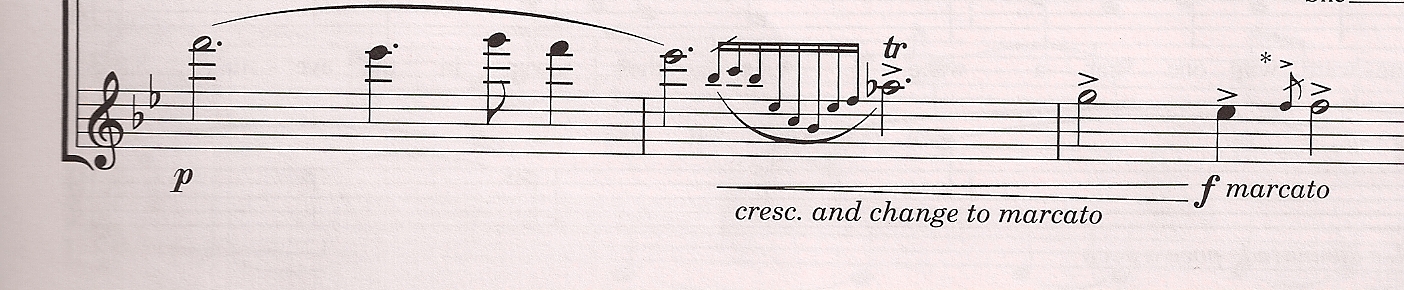
She Moved through the Fair from John Corigliano’s Three Irish Folksong Settings is a good example.  I was just practicing it for Asterisk’s performances at Old Songs Festival last week.  Here are two phrases from the piece:

corig 3-1
corig 3-2

As you can see, they are very similar, though they are not strict repetitions of each other.

You might think, on first glance, that you could be extra efficient with your memorizing by learning both phrases at once, maybe by alternating between the two over the course of your repetitions.  That method, however, turns out to be much less efficient than memorizing them one at a time.

You need to make a separate place in your brain for each of those phrases.  The grooves are similar, yes, but they have to be separate.  And try as you might in this age of multitasking, your brain can only learn one thing at a time.

So start by learning the first phrase, all by itself.  Use the Post-it trick, or do whatever you need to resist the temptation to learn both phrases at the same time.  When you work on the second phrase, it’s OK to use your knowledge of the first as the starting point in your process.

In the example of the Corigliano, that would mean saying to yourself something like: “This is just like the opening phrase, but the rhythm is reversed in the second beat, and it ends with a trill on the A-flat and accents.”  Then, the more you practice it, the more it will start to take on its own character and its own place in your brain.  You will find that learning this second version of the phrase takes way less time than the first.

Not only do you need to practice similar phrases each on their own, but this can be most effectively done by separating the practice sessions in which you practice them.  For example, if you’re working on the fist phrase of the Corigliano on a Monday, come back to the second phrase on Tuesday, or better yet, on Friday (practice something else on the days in between).  This gives the first phrase a nice long time to gel in your mind before you challenge your brain with something that is so similar to it.

If you come back to the second version too quickly, before the first has had that time to sink in, your brain will think you’re just adding new information to the first groove, not that you are creating a new one, and you’ll find yourself confused in performance over which is which.

Photo credit: jonathan.youngblood

7 Ways to Make your Practicing more Efficient and Effective Starting TODAY

June11

stretch

1.  Do a thorough physical warm-up. Physical warm-ups not only prevent injury, they make your practice more efficient. If you start practicing without doing a warm-up first, your body is going to be trying to do two things at once:  warming itself up to the task of playing and learning the new skill you are practicing.  Eventually, you will probably accomplish both those tasks, but you’d be able to do it faster and easier if you did them one at a time.  You can find my suggestions on physical warm-ups by clicking on “Physical Warm-ups” on the Categories tab at the right.

2.  Incorporate mental practice into your routine. Study after study has shown that some form of mental practice, separate from physical practice, enhances any skill you are trying to develop, whether it’s playing a sport or playing an instrument.  Why not experiment with one of the following techniques, even for just a few minutes a day?

  • Visualization: Imagine yourself playing beautifully in your upcoming concert or audition.
  • Score study: Notice how the piano part fits with yours.  Look for melodic and harmonic patterns.  Apply some of that stuff you learned in theory class to your own music!
  • Memorization: Try beginning the memorization process away from your instrument. Study the music phrase by phrase as you would if you were practicing with the instrument.
  • Practice the thought process you use while playing the piece. Page through the score while reminding yourself of the various things you need to think and do while playing the piece (make sure not to play this phrase too loudly, match the pitch of the horn on this note, use this long rest to relax the shoulders, etc).

3.    Practice the hard parts first. (after having done a good warm-up of course!) Jump into the deep end! When you practice the most challenging part of a piece of music, you are not only getting better at the piece, you’re getting better at your instrument.  So mastering the hard parts of a piece first will make the easy parts even easier, and therefore take even less time to practice.

4.    Be ruthless when isolating the problem spots. Sometimes the main obstacle to playing a difficult passage can be narrowed down to a single interval.  Tedious though it may seem to practice just two notes, it is way MORE efficient (and way LESS tedious) than slogging through an entire phrase over and over again.

5.    Close the door. Having a private space in which to practice can have a profound impact on your ability to concentrate. While you’re at it, you could also try turning off the phone and putting the computer to sleep.  If you don’t have a room in which to practice (for example, if you practice in your family’s living room), you can still find a way to metaphorically close the door—face your music stand away from the hall where people might be walking by or away from your sister sitting on the couch…

alarm-clock

6.    Plan and take breaks. Give yourself a time limit and stick to it.  If you’ll be practicing for an hour, take a 5-minute break after half an hour.  You’ll come back refreshed, and your second half-hour of work will be more productive than it would have been if you had just plowed through.  Pilots are required to take breaks, and musicians should be too! For more on breaks, see this post.

7.    Keep a log. Think today about what you need to practice tomorrow and write it down.  It’ll save you the time of idly playing through your piece at your next session, trying to remember which spot you thought needed attention. I saved this one for last, since technically, it won’t improve your practicing until tomorrow.  For more on the value of keeping a practice notebook, check out my first and second posts.  And be sure to read the comments, as readers have posted some interesting ideas on the topic.

notebook

Photo credits: Stretch is by That Guy Who’s Going Places;  Clock is by inocuo;  Notebook is by *spudballoo*

Memorization & Working Memory

May19


piano-and-hands1


WARNING:  This post includes a good quantity of amateur neruoscience.  Proceed with caution.


I’d like to explain a bit about how my memorization technique works.


When I was first doing a lot of memorization (before I had developed the technique), I noticed that I could often play a passage from memory after only a few repetitions attempting to memorize it.  The thing was, I could usually only successfully play it from memory once or maybe twice that way, and when I came back to it the next day, I had to start completely over again.  It seemed like there was some sort of shallow or short-term memory at work.


Years later, I learned that particular kind of short-term memory has a name: working memory.  It’s kind of like the clipboard function on your computer—your brain is capable of remembering a certain amount of information right at the front of your brain for the period of time with which you are actively working on it.  But, like the clipboard function when you turn off your computer (i.e. end your practice session), you lose that slate of information.


I developed my memorization method as a means of converting shallow working memory into something deeper, longer-term, and more dependable.  I wanted to be sure the information had passed from my working memory (which is only good for a day or two) into the long-term memory banks of my brain where I could call it up whenever I needed it (i.e. on stage in a month). 


I think the two key processes that effect the conversion from working memory to long-term memory are the close observation of detail (making your memory more specific and full, as opposed to general and shallow) and the isolation of mental practice from physical practice.


So, put on your amateur neuroscientist lab coat, and let’s look at the method from that point of view:

1.   Play your chosen passage through twice, reading the music and observing as much about it as you can (close observation of detail).

2.   Think it through once:  this is working memory in action.  While you are thinking it through, be aware of any information your working memory has missed (Is the last note a B or B-flat?  Is there a dynamic change somewhere?  What about the articulations?)

3.   Play it through once, reading the music.  This is where you fill in the blanks left by your working memory (remember it’s shallow and misses things).

4.   Think it through twice:  by the second time, you will be relying more on a deeper kind of memory than shallow working memory.


The second stage adds in the physical part. By its very nature, physical practice (actually playing the music) will generate muscle memory:  your fingers start to know what notes to play all by themselves. Muscle memory is a great thing, and can be a big help if you get distracted when in performance:  your muscles take over while you are thinking of something else, and, hopefully, the audience is none the wiser.


However, during the process of memorization, muscle memory can be a real problem:  it can create the illusion that you know a passage when, really, only your fingers know it.


I do the mental work first because when performing from memory, it is most effective for information to flow from your brain to your fingers, not vice versa.  Separating mental practice from physical practice bypasses muscle memory and allows you to get the information deep into your brain’s hard drive, where you can call it back when you need it.  Then, in stage two, you take what you learned mentally in stage one, and manifest it physically.  You practice converting knowledge (memory) into action (playing), which further cements your memorization of the piece.  This allows muscle memory to serve as your “backup” in case of emergency.


Photo credit:  Arwen Abendstern

Memorization: The Post-it Trick

May5

horse-with-blinders-bw

One of the keys to successful and pain-free memorization is to only memorize very small sections at a time.

The Problem

Working on only small sections sounds simple enough, but memorization is a tricky business.  It can be really tough, psychologically, to make yourself concentrate on only a very small section at time when you really want to be playing the whole piece.  Good music has a certain feeling of inevitability about it:  one phrase naturally leads to the next and seamlessly carries you and the audience through time.  And the better the music, the stronger that sense of inevitability.  So it can be really hard to make yourself stop at the end of a single phrase.

Flutists, try the first page of the Martin Ballade, and you’ll know what I mean.

If the music is very complicated, with lots of notes and accidentals, you might find yourself deciding to work on memorizing only a portion of a phrase.  And that, my friends, is an even tougher discipline:  to play, over and over, just half of a phrase!

The Solution

So what’s a flutist (or any other musician trying to memorize) to do?  My solution is to put blinders on, just like one puts on a horse drawing a carriage.  The easiest way I’ve found to do this is with Post-its:  I cover up the music that I am not memorizing, making it way easier to focus on only the section I’ve chosen.

Usually it’s enough to just cover the next few notes with a single Post-it:

img_2708

But if I’m really having a hard time focusing, I’ll cover up the whole next phrase, and even some of the previous one:

img_27241

A Related Problem

Another common memorization pitfall is giving in to anxiety about learning the entire piece, when what you need to be doing is simply concentrating on a small section.  This is totally normal, of course:  who hasn’t said, or heard a colleague say, “I can play the little sections, it’s playing the whole thing that’s hard?”

When I get caught up in that particular brand of anxiety, my inner monologue goes something like this:  Well, this phrase may be important, but what about the next one?  And the one after that?  And that tricky one at the end? I sometimes get so caught up in the enormity of the task (Play the entire Ibert Concerto from memory?  Seriously?), that it’s hard to concentrate on the small, manageable task of learning one small section at a time, even though in this blog I’m always singing the praises of small sections.

The Same Solution

The Post-it trick is not just a visual focus aid, it also helps you psychologically by hiding the enormity of the job.  It’s similar to when long-distance runners use “short focus:” they look only a few steps ahead at a time, and then can run a whole marathon that way.  It’s also a great trick for getting up hills, since at a short focus, it’s hard to perceive the slope of the hill.  Which is just like using the Post-it trick to keep you looking only at a small section, and not thinking about the whole piece.

Some Details

I’ve also learned to use Post-its in dark colors, or to use two of the light yellow ones, so that I’m not tempted to just read the music through the Post-it.  Another good way to maximize Post-it opacity is to put the sticky part a little above the music you want to hide, as the part of the Post-it that sticks off the music is less see-through.

If you don’t have a stack of Post-its at the ready, you can just use folded up scrap paper:

img_2728

Horses wear blinders so that they don’t get spooked by other traffic on the road, and musicians need them for a similar reason.  By putting Post-it blinders on, you make it easier to concentrate on the small section you want to practice.  And, perhaps more importantly, this keeps you from getting spooked by the things you are choosing not to concentrate on.

P.S.

horse-with-blinders-and-traffic

In this photo, the horse is you.  The people on the motorcycle are the phrase after the one you’re practicing, and the tanker is the looming fear of playing the whole piece from memory…I think you get the picture!

Photo Credits: Black and white photo of horse: DMahendra Color photo of horse in traffic: Randy Son of Robert Other photos: me!

How I Memorize Music

April6

eyes-covered

When I was first starting to do a lot of playing from memory (preparing for a big competition in my first year of graduate school), I wanted to have some sort of method that would help me feel certain that I had studied the music enough to know it for sure.   I thought that if the process of memorization felt systematic, I could be sure my preparation was thorough, which would translate into more confidence on stage.

I developed the following system at that time, and it has served me well in the years since.  I will devote future articles to some of its finer points, and why it works.  For today, however, I’ll cover the basic steps, so you can start using this system immediately.

The first thing you need to do is choose a short passage to memorize.  The principle of small sections is absolutely crucial to successful memorization – I can’t stress this enough! Please read my previous post on the topic of small sections if you need more information.

Once you’ve chosen your section, here’s what you do:

First stage:  Learning the passage mentally

1.    Play the passage twice through, reading it from the music, with the metronome on.
2.    Now, without looking at the music, think the passage through once at tempo (i.e., keep the metronome on).
3.    Play the passage once more while reading the music, noting anything that you forgot or didn’t know when you thought it through.
4.    Look away from the music, and think the passage at tempo another two times.

Total:  six times, three times playing from the music, three times thinking it through without the music

Second stage:  learning the passage physically

1.    Play the passage twice through, reading it from the music, with the metronome on.
2.    Now, without looking at the music, play the passage once through at tempo (keep the metronome on).
3.    Play the passage once more while reading the music, noting anything that you forgot or didn’t know when you thought it through.
4.    Look away from the music, and play the passage at tempo another two times.

Total:  six times through, three times playing from the music, three times playing from memory

Grand total:  twelve times through

For a slow passage, one or two times through this whole process is often enough to get it memorized.  Even if this process takes less than 10 minutes, I only do it one time through in a single practice session.  I come back to it the next day if I feel the passage needs another cycle through the memorization process.

For a fast passage that is technically challenging, here’s my routine:

  1. First I do the whole process, all twelve repetitions, at a slow tempo (often a tempo even slower than where I would start if I were merely working on the passage technically)
  2. Then I work on the passage using Metronome Trick No. 1, and at every tempo level I do the following:
  3. a.    One time through mentally, at tempo
    b.    Two times through playing while reading
    c.    One time through playing from memory
    d.    One time through playing while reading
    e.    Two times through playing from memory

Basically, at each tempo level you go through the passage once mentally, and then go through the entire second stage of memorization.

If you would like a cheat sheet that lists the basic steps of this memorization technique, here it is: memorization-cheat-sheet (click to download as a pdf).

As you try this technique, know that your skill with it will develop slowly, but it will improve over time. If at first you don’t succeed, try again with a shorter section of music.  There have been occasions (most notably complicated music like the Ibert Concerto) when I have memorized one beat at a time!

I find that working from memory is like developing any other skill—it gets easier as you get more proficient.  Your memory, just like your muscles, can be ‘in shape,’ and when it is, memorization happens faster.  And when you’re just starting, you need to start with small units, just as you would start with small weights for your first day at the gym.

NOTE:  This is the first in a series of articles about memorization.  If there are any particular aspects of working from memory that are of interest to you, or you have questions about the techniques I share, please leave a comment below, and I will endeavor to answer those questions in future posts.

Photo Credit:  http://www.flickr.com/photos/derricksphotos/2172690132/


RSS