The Practice Notebook

flutist Zara Lawler shares tips on learning music

Reader Question: New Instrument

March25

Greetings, all, and happy spring!

Thanks to all who have been reading, and sending in questions and comments.  I intend to post some more reader-inspired articles from time to time.  So, if you have a question, feel free to email it, or add it as a comment to a post.  I will try my best to reply (though as Richard, today’s question author, can attest, it may take a while).

Below is Richard’s email on a very interesting topic:  adjusting to a new instrument.  He has kindly accepted my request to post his email and my response.

Hi Zara,

I came across your website while trying to answer a question for myself.  I recently got a good flute – a Muramatsu DS – and am finding that it is teaching me a lot.  I’ve never had a good flute so it is quite eye-opening.  I can find a great sound on every note, but it seems I don’t get to the point of the sound being fairly consistently good until I’ve played for 45 minutes or so.  I think the flute may be forcing me to work my embouchure in ways that my previous flute did not. It rewards me for the work – eventually  – with a great sound – but I think I’m also fatiguing my embouchure – over practicing a bit.  Oddly enough it’s feels more like it’s my lower lip – not my upper lip – that gets fatigued.   My lower lip seems to not be able to hold the position it needs to get a good sound.

Does any of this sound familiar?  Is it possible to over practice and fatigue the embouchure?  Thanks for any advice you might have, particularly how I can get to the point where I can practice 2 – 3 hours and just be fine.

Richard

P.S. – If you have CDs I can buy please let me know.

Dear Richard,

Thank you for your email and question.  I want to apologize for taking so long to get back to you by way of saying, yes, that does sound familiar.  In fact, I spent part of the month of January over-practicing myself!  Hence the decreased time for keeping up with my blog and for writing thoughtful replies to good questions like yours.  Sigh.

First of all, congratulations on your new flute!  A good instrument can be a good teacher, as you are finding out.  I’m guessing that some of your frustration is due to a phenomenon that I haven’t covered in my blog yet:  your brain is ahead of your body.  Now that you have a new flute, and you hear yourself sounding so much better than you have in the past, your brain has made a cognitive leap, and decided that you should sound that good, or even better, all the time.  And trust me, with your drive and willingness to work, you will.

The problem is that it takes your body a lot longer to learn a new skill than it takes your brain to set a new standard.  Your ear hears yourself sound even marginally better on your Muramatsu, and instantly your brain gets all sorts of grand ideas about how you should sound all the time.  It might take your body weeks or months to learn how to sound that way—not only to figure out what the various muscles of your embouchure need to do, but to develop the strength to do them consistently.  In the meantime, though, your lips are straining to achieve that sound all the time, and getting fatigued in the process.

If you have friends who play brass instruments, you’ve probably heard from them about how over-practicing can really harm their “chops” and compromise the quality of their sound.  The same is definitely true for flute players.  I think, though, that because our embouchure is, by definition, more gentle (we don’t buzz, we are not squashing our entire embouchure against the mouth piece, the air pressure we use is so much less, etc), we can generally go much longer than brass players before this happens, and that’s why you don’t hear about it for flute players so often.

This is one of the reasons I stick by the 30-Minute Rule .  Even on days that I practice 4 hours, I take breaks every 30 minutes, because without them, my sound starts to suffer, because my lips (and brain) start to get overtired.

Every once in a while I break the 30-Minute Rule, and I always notice that my sound gets worse, and I start to go a little crazy. This January I was trying to learn some new pieces for a recital, so I kept saying to myself, “Well, I’ll just practice a few more minutes, since I REALLY need to learn this music…”  And after a few sessions like that, I find myself thinking, “Wow, why do I sound so bad?  With all this practicing, I should be sounding great.”  Then I remember the 30-Minute Rule, and get back to it, and suddenly I sound better again.

So, when you say that you’d like to be able to play 2 to 3 hours at a time, I counsel you strongly to integrate breaks into those hours.  If you think about it, a professional orchestral flutist not only has breaks written into her contract, but she isn’t playing for every moment of the rehearsal.  There are rests written into the score; the conductor takes time to work with the strings alone; etc. You need to build that same kind of rest time into your practice routine.

Try sticking to the 30-Minute Rule, and working regular breaks into your practice time.  Try taking the long view, and trusting that your physical abilities will develop over time to match your new instrument’s potential.  If after another couple of weeks you are still feeling this same frustration, particularly that it takes you so long to get to the point of feeling warmed up, then it may be that you need a better warm up routine, or some other fix.

Hang in there, and enjoy your new instrument.

Sincerely,

Zara

PS.  At the moment, I don’t have any CD’s for purchase, but I hope to have one in the next year.  I’ll keep you posted.  In the mean time, you might enjoy this webcast of a recent concert.

Photo Credit:  D Sharon Pruitt

Separate Like from Like

July8

[Note: This principle applies to regular practice as well as memorization, but for the purposes of today’s post, I will focus on memorization.]

record player

An old fashioned LP works like this:  it has a single groove that spirals around the record.  You place the needle in the groove, and as the record spins, it traces the entire length of the groove seamlessly from start to finish.

Your brain is a little bit like that when you have learned a piece of music really well.  You have created a neural pathway, or series of pathways, that are as smooth and inevitable as the groove in a record.  And though ultimately that pathway will carry you from start to finish of a piece, you create it by making only small sections, (the length of a phrase or less) at a time. Each phrase you learn is like a little groove in your brain.

Most pieces of music repeat themselves at some point: it’s compositionally sound to do so, for example, at the recapitulation of a sonata form piece. Similar phrases have similar grooves, and they need to be practiced with special care.

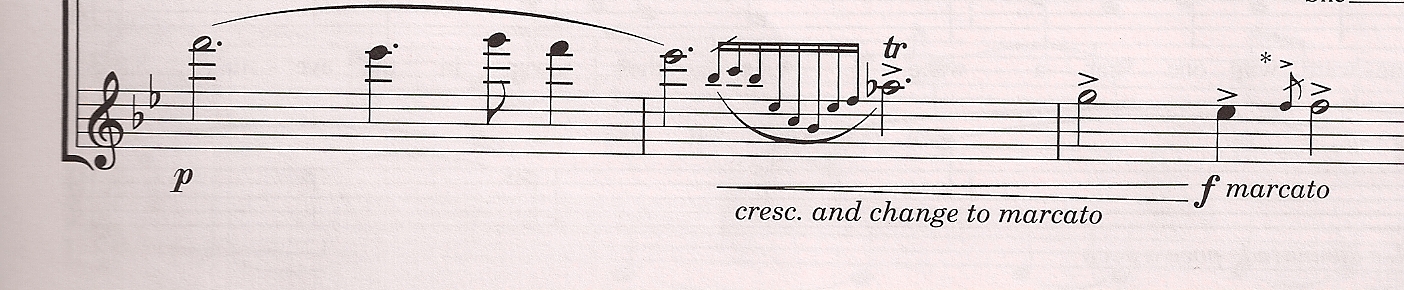
She Moved through the Fair from John Corigliano’s Three Irish Folksong Settings is a good example.  I was just practicing it for Asterisk’s performances at Old Songs Festival last week.  Here are two phrases from the piece:

corig 3-1
corig 3-2

As you can see, they are very similar, though they are not strict repetitions of each other.

You might think, on first glance, that you could be extra efficient with your memorizing by learning both phrases at once, maybe by alternating between the two over the course of your repetitions.  That method, however, turns out to be much less efficient than memorizing them one at a time.

You need to make a separate place in your brain for each of those phrases.  The grooves are similar, yes, but they have to be separate.  And try as you might in this age of multitasking, your brain can only learn one thing at a time.

So start by learning the first phrase, all by itself.  Use the Post-it trick, or do whatever you need to resist the temptation to learn both phrases at the same time.  When you work on the second phrase, it’s OK to use your knowledge of the first as the starting point in your process.

In the example of the Corigliano, that would mean saying to yourself something like: “This is just like the opening phrase, but the rhythm is reversed in the second beat, and it ends with a trill on the A-flat and accents.”  Then, the more you practice it, the more it will start to take on its own character and its own place in your brain.  You will find that learning this second version of the phrase takes way less time than the first.

Not only do you need to practice similar phrases each on their own, but this can be most effectively done by separating the practice sessions in which you practice them.  For example, if you’re working on the fist phrase of the Corigliano on a Monday, come back to the second phrase on Tuesday, or better yet, on Friday (practice something else on the days in between).  This gives the first phrase a nice long time to gel in your mind before you challenge your brain with something that is so similar to it.

If you come back to the second version too quickly, before the first has had that time to sink in, your brain will think you’re just adding new information to the first groove, not that you are creating a new one, and you’ll find yourself confused in performance over which is which.

Photo credit: jonathan.youngblood

New Category: Amateur Neuroscience

June17

hands for amateur neuroscience

One of my favorite things about practicing and writing about practicing, is thinking about how the brain (ok, ok, MY brain) works.  There’s a fancy word for that which I just learned from an article in the New Yorker:  metacognition, or literally, thinking about thinking.

I like to think of myself as an amateur neuroscientist, and the practice room (and my own brain) as my lab.  (On a side note, it would be cool to have one of those yellow and black warning diamonds to hang up on the door that says, “Amateur Neuroscientist At Work.”) Over the years in my lab I’ve learned a lot about how my brain works, and what things I need to do to keep it working at its best. I’ve reflected on how my colleagues’ and students’ brains work, too.

I’ve recently had the gratifying experience of  discovering that actual neuroscience backs up some of my observations.  For example, in developing my memorization technique, I didn’t know about working memory as a scientific concept.  I merely observed that I could remember a phrase for the duration of a practice session and then it would be gone. It was only years later that I learned it has a name, and that people have studied it, and given it the names “working memory” and “channel capacity.”

Also, I’ve always had the sense that when you first learn something (like in the first stages of memorization), it just goes into the front of your brain.  To me, it literally feels like it’s right there, just tucked into my forehead.  Well, it turns out, that’s where working memory happens!  It’s mostly all in the frontal cortex, which is “the overhang of brain behind the eyes” (New Yorker, May 18 2009 p 31).  How cool is that?

All this thinking about thinking about thinking has led me to think (whew!) that a new category of post is in order:  Amateur Neuroscience.  You can click on it from the “Categories” sidebar at right and see all the posts organized under this topic.

three beakers

Let me clarify what I mean by “amateur.”  The vast majority of the writing that I have done about how the brain works is based on close self-observation, not on scientific study!  When I can back up a concept that I use with some actual science, I will note it, as I have with the New Yorker article citation above.

If you are looking for more actual neuroscience, let me point you to a few resources. In the interest of full disclosure,  my research on this topic has not been exhaustive, but I do have a few recommendations for reading. Should you have some books or sites that you’d like to recommend on the topic, please let me and the readers know via the comments section below.

Below are a few books and articles that I have found interesting, though none of them directly address the relationship of neurological ideas to the study of music:

And below, a list of sites and books that I have only dipped my foot in but look like they’ve got LOTS of cool information:

Three books worth checking out, about the study of music:

See you in the lab.

Photo Credits: Hands by Q U E E F, Beakers by skycaptaintwo


RSS