The Practice Notebook

flutist Zara Lawler shares tips on learning music

Defense against the Dark Arts for Musicians

July23

stop voldemort

Sometimes a life in music can feel pretty crappy.  You love the music so much, it’s hard to ever feel satisfied with the way you play it, or a big concert is coming up and the stakes seem so high that you walk around with your stomach a knot of fear all day.  Negative voices in your head say you’ll never be “good enough.”  When the negativity really gets going, it can feel like a Dementor attack, straight out of Harry Potter.

For those of you who aren’t up on your Harry Potter, Dementors are the guards of Azkaban, the wizarding prison.  They feed on all human negative emotion, and when they attack, they literally suck the soul right out of you.  If you haven’t read Harry Potter, but you HAVE gotten all worked up about a concert or an audition, you probably know a little what it feels like to have the soul sucked out of you.  Sure, Harry Potter is fiction, but the ability of negative thoughts to suck at your soul is, unfortunately, all too true.

So what’s a musician to do?

I recently got a great pep talk on this very topic from my dear friend, soprano Mary Ellen Callahan.  I was confessing to her the great fear I have been feeling while practicing for my upcoming performance at the NFA Annual Convention.  It’s that kind of fear that just sits at the bottom of your stomach, present as you do your daily routine like practicing or washing the dishes.  It had gotten to the point that I had a hard time even doing positive visualizations, because the fear was dominating my mind.

Mary Ellen suggested thinking of a time that I felt really good performing—even if it was a different piece, and then once I was nicely in that memory, I could just slip in a new visualization of me playing the music I’m working on now, but feeling as good as I did in the memory.  It’s like reminding yourself of what feeling good was, and then bringing that feeling into the present (and, ultimately, the future).

It just so happens that later that same day, I watched Harry Potter and the Prisoner of Azkaban on TV, and realized that basically Mary Ellen was suggesting a kind of real world Patronus Charm.  You remember the Patronus Charm:  that’s when a wizard thinks of his very best memory, a time when he was really really happy, and thus can conjure up a magical shield that protects him from Dementors.

So, for my practicing, I’ve remembered a few times when I felt really in the zone, when time slowed down, and I felt like I could do anything.  Then, as Mary Ellen suggested, I pull a fast one on my mind, and switch the original piece with Lowell Liebermann’s Eight Pieces. It’s worked pretty well so far.  Not only has it helped me to feel more calm as I practice, it has also made my practicing more effective.  On a couple of occasions, things that normally would take me two 10-minute segments to learn got done in less than one!

Also in The Prisoner of Azkaban, Harry and his classmates learn the Riddikuls charm to ward off boggarts.  A boggart is a magical creature that takes on the form of your worst fears, and it is disarmed by turning it into something funny.  For example when Ron’s boggart takes the shape of a giant spider, he envisions it on roller skates and the hilarity of the image of a spider skittering around on eight sets of wheels robs the boggart of its fear-fuelled power.

I’ve been using the Riddikulus Charm like so:

Fear:  Me at the NFA Convention:

TalesAndScales2007a-551

Riddikulus!

ridikulus
Yes, that IS Sir James Galway’s head on my body.  Riddikulus indeed!
What do you think is riddikulus?  How would you re-envision a scary performance to make it funny?  Whose head would you put on your body?  Send them in, please!

PS.  In case you need a little more Harry Potter inspired humor, go here and watch my Asterisk colleague Meaghan Heinrich doing her amazing “Baby Got Wand” as H. Pizzle himself.

PPS.  Photo credits:  Stop Voldemort by Ellie, Me in Krishna pose by Mike Wheatley, Sir James in Krishna pose by me.

The Ritual Power of Physical Warm-ups

July17

yoga on beach

Do you need another reason to add physical warm-ups to your daily practice routine? Here it is: As a ritual, your physical warm-ups can have a profoundly positive impact on your experience of performing. Those stretches and exercises that you do every day can eventually become a ritual that  focuses your mind and readies your spirit for the act of making music.

If you’ve ever been to a religious service, you’ve seen many examples of rituals:  from the small and simple gesture of bowing one’s head in prayer to the more involved actions surrounding Communion or Baptism (can you tell I have a Catholic background?). A secular example is the ceremonial taking down and folding of the flag at the end of the day.  Simple or complex, a ritual is a physical pattern one follows that has symbolic meaning.

One of the important things about a ritual is exactly that symbolic meaning, its spiritual/emotional/mental component.  Let’s take genuflecting as an example: the physical act is touching the floor with one knee, at the end of a pew, but the symbolic meaning is something along the lines of “I bow before God to show respect and receptivity.” Compare this to the case of your physical warm-ups:  while you are literally stretching certain muscles, you are symbolically saying, “Now I am getting ready for my regular practice.” (The key word in that sentence is “regular.”  A warm-up routine will not become a ritual unless you do it every time you practice.)

prayer

Yet the benefits of your warm-up ritual go beyond just signaling your readiness to practice. First,
you can use your warm-up ritual to great effect before performances.  Performing can be so anxiety-making because it is so unusual; relative to how many times you practice, you perform very little.  Doing your daily ritual warm-up before a performance can put you into (or closer to) your daily mindset.  It’s like saying to yourself, “Ok, no big deal.  This is just another practice day,” which in turn makes you feel more calm, and lowers the emotional stakes.

Another benefit is a little harder to describe, but no less important in the long run.  When you incorporate physical warm-ups into your daily practice, you eventually create a higher meaning to the physical work.  You not only ready your body to play, but you ready your mind and even spirit to play.  Your mind gets focused, and your spirit opens up to the power of music.  In short, you become more fully present.  There’s a reason all religions have rituals:  they work.

I experienced this in a very strong way last year—not before a performance but before my wedding!  [include pic]  On the morning of the big day, I was pretty excited, and pretty nervous, and was not at all sure what to do to get ready.  I had carved out a little bit of ‘alone time’ in the morning, and found myself pacing around the room, at a loss for how to prepare for this once-in-a-lifetime event.  You know when you’re so nervous that you feel trapped inside yourself, and not present to the place or other people around you?  That’s how it was.

I don’t know what possessed me to do it, since really, a wedding is not a concert, but I thought I’d do my flute stretches.  I guess it’s just because that’s what I usually do to prepare for something big.

0508

The happy brides (I'm the one with blond hair)

It was amazing how effective it was. I went from feeling a little crazy and a lot nervous to thinking, “Oh, I’m me.  I’m ready to go.”  I felt like not only did my shoulders drop from up around my ears, but I became present to the moment: my mind focused and my spirit relaxed.

So if a few stretches, slowly crafted into a ‘get ready’ ritual over years of practice, can do that for a nervous bride, imagine what they can do for you before your next performance!  Get started now, and you’ll experience the benefits over your whole career.

PS.  If you’d like some suggestions on what stretches to do on a daily basis, click on “Physical Warm-ups” on the Categories sidebar at the right, and you can watch my video instructions on neck, shoulder, arm and hand stretches.

Photo Credits:  Yoga on the Beach by mikebaird, Prayer by prakhar, Wedding photo by Derek Goodwin

Separate Like from Like

July8

[Note: This principle applies to regular practice as well as memorization, but for the purposes of today’s post, I will focus on memorization.]

record player

An old fashioned LP works like this:  it has a single groove that spirals around the record.  You place the needle in the groove, and as the record spins, it traces the entire length of the groove seamlessly from start to finish.

Your brain is a little bit like that when you have learned a piece of music really well.  You have created a neural pathway, or series of pathways, that are as smooth and inevitable as the groove in a record.  And though ultimately that pathway will carry you from start to finish of a piece, you create it by making only small sections, (the length of a phrase or less) at a time. Each phrase you learn is like a little groove in your brain.

Most pieces of music repeat themselves at some point: it’s compositionally sound to do so, for example, at the recapitulation of a sonata form piece. Similar phrases have similar grooves, and they need to be practiced with special care.

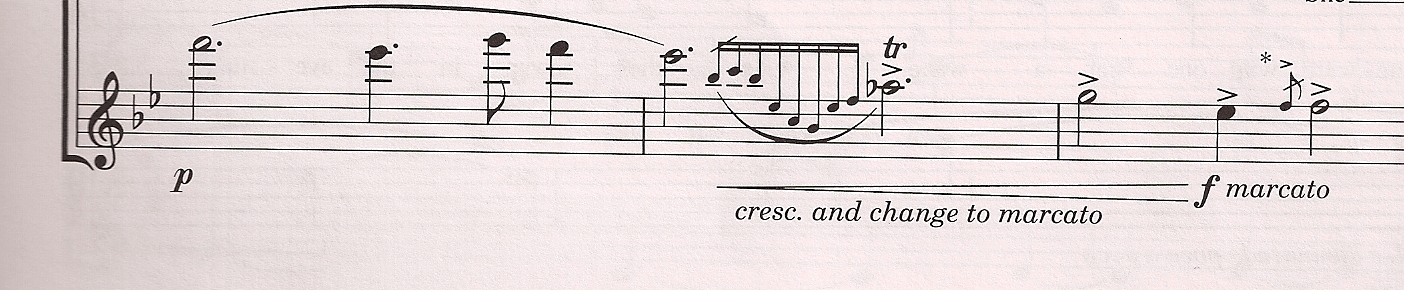
She Moved through the Fair from John Corigliano’s Three Irish Folksong Settings is a good example.  I was just practicing it for Asterisk’s performances at Old Songs Festival last week.  Here are two phrases from the piece:

corig 3-1
corig 3-2

As you can see, they are very similar, though they are not strict repetitions of each other.

You might think, on first glance, that you could be extra efficient with your memorizing by learning both phrases at once, maybe by alternating between the two over the course of your repetitions.  That method, however, turns out to be much less efficient than memorizing them one at a time.

You need to make a separate place in your brain for each of those phrases.  The grooves are similar, yes, but they have to be separate.  And try as you might in this age of multitasking, your brain can only learn one thing at a time.

So start by learning the first phrase, all by itself.  Use the Post-it trick, or do whatever you need to resist the temptation to learn both phrases at the same time.  When you work on the second phrase, it’s OK to use your knowledge of the first as the starting point in your process.

In the example of the Corigliano, that would mean saying to yourself something like: “This is just like the opening phrase, but the rhythm is reversed in the second beat, and it ends with a trill on the A-flat and accents.”  Then, the more you practice it, the more it will start to take on its own character and its own place in your brain.  You will find that learning this second version of the phrase takes way less time than the first.

Not only do you need to practice similar phrases each on their own, but this can be most effectively done by separating the practice sessions in which you practice them.  For example, if you’re working on the fist phrase of the Corigliano on a Monday, come back to the second phrase on Tuesday, or better yet, on Friday (practice something else on the days in between).  This gives the first phrase a nice long time to gel in your mind before you challenge your brain with something that is so similar to it.

If you come back to the second version too quickly, before the first has had that time to sink in, your brain will think you’re just adding new information to the first groove, not that you are creating a new one, and you’ll find yourself confused in performance over which is which.

Photo credit: jonathan.youngblood

Postcard from Old Songs

June27

I’m here at the Old Songs Festival, with my ensemble Asterisk.

old songs stage

We are having a great time, and have spent so much of the last week rehearsing and practicing that I haven’t managed to put together a post about practicing.

If you are in  New York, and can get to the Albany area, come and check us out.

I’ll have a full post for you next week…in the meantime, happy practicing!

New Category: Amateur Neuroscience

June17

hands for amateur neuroscience

One of my favorite things about practicing and writing about practicing, is thinking about how the brain (ok, ok, MY brain) works.  There’s a fancy word for that which I just learned from an article in the New Yorker:  metacognition, or literally, thinking about thinking.

I like to think of myself as an amateur neuroscientist, and the practice room (and my own brain) as my lab.  (On a side note, it would be cool to have one of those yellow and black warning diamonds to hang up on the door that says, “Amateur Neuroscientist At Work.”) Over the years in my lab I’ve learned a lot about how my brain works, and what things I need to do to keep it working at its best. I’ve reflected on how my colleagues’ and students’ brains work, too.

I’ve recently had the gratifying experience of  discovering that actual neuroscience backs up some of my observations.  For example, in developing my memorization technique, I didn’t know about working memory as a scientific concept.  I merely observed that I could remember a phrase for the duration of a practice session and then it would be gone. It was only years later that I learned it has a name, and that people have studied it, and given it the names “working memory” and “channel capacity.”

Also, I’ve always had the sense that when you first learn something (like in the first stages of memorization), it just goes into the front of your brain.  To me, it literally feels like it’s right there, just tucked into my forehead.  Well, it turns out, that’s where working memory happens!  It’s mostly all in the frontal cortex, which is “the overhang of brain behind the eyes” (New Yorker, May 18 2009 p 31).  How cool is that?

All this thinking about thinking about thinking has led me to think (whew!) that a new category of post is in order:  Amateur Neuroscience.  You can click on it from the “Categories” sidebar at right and see all the posts organized under this topic.

three beakers

Let me clarify what I mean by “amateur.”  The vast majority of the writing that I have done about how the brain works is based on close self-observation, not on scientific study!  When I can back up a concept that I use with some actual science, I will note it, as I have with the New Yorker article citation above.

If you are looking for more actual neuroscience, let me point you to a few resources. In the interest of full disclosure,  my research on this topic has not been exhaustive, but I do have a few recommendations for reading. Should you have some books or sites that you’d like to recommend on the topic, please let me and the readers know via the comments section below.

Below are a few books and articles that I have found interesting, though none of them directly address the relationship of neurological ideas to the study of music:

And below, a list of sites and books that I have only dipped my foot in but look like they’ve got LOTS of cool information:

Three books worth checking out, about the study of music:

See you in the lab.

Photo Credits: Hands by Q U E E F, Beakers by skycaptaintwo

7 Ways to Make your Practicing more Efficient and Effective Starting TODAY

June11

stretch

1.  Do a thorough physical warm-up. Physical warm-ups not only prevent injury, they make your practice more efficient. If you start practicing without doing a warm-up first, your body is going to be trying to do two things at once:  warming itself up to the task of playing and learning the new skill you are practicing.  Eventually, you will probably accomplish both those tasks, but you’d be able to do it faster and easier if you did them one at a time.  You can find my suggestions on physical warm-ups by clicking on “Physical Warm-ups” on the Categories tab at the right.

2.  Incorporate mental practice into your routine. Study after study has shown that some form of mental practice, separate from physical practice, enhances any skill you are trying to develop, whether it’s playing a sport or playing an instrument.  Why not experiment with one of the following techniques, even for just a few minutes a day?

  • Visualization: Imagine yourself playing beautifully in your upcoming concert or audition.
  • Score study: Notice how the piano part fits with yours.  Look for melodic and harmonic patterns.  Apply some of that stuff you learned in theory class to your own music!
  • Memorization: Try beginning the memorization process away from your instrument. Study the music phrase by phrase as you would if you were practicing with the instrument.
  • Practice the thought process you use while playing the piece. Page through the score while reminding yourself of the various things you need to think and do while playing the piece (make sure not to play this phrase too loudly, match the pitch of the horn on this note, use this long rest to relax the shoulders, etc).

3.    Practice the hard parts first. (after having done a good warm-up of course!) Jump into the deep end! When you practice the most challenging part of a piece of music, you are not only getting better at the piece, you’re getting better at your instrument.  So mastering the hard parts of a piece first will make the easy parts even easier, and therefore take even less time to practice.

4.    Be ruthless when isolating the problem spots. Sometimes the main obstacle to playing a difficult passage can be narrowed down to a single interval.  Tedious though it may seem to practice just two notes, it is way MORE efficient (and way LESS tedious) than slogging through an entire phrase over and over again.

5.    Close the door. Having a private space in which to practice can have a profound impact on your ability to concentrate. While you’re at it, you could also try turning off the phone and putting the computer to sleep.  If you don’t have a room in which to practice (for example, if you practice in your family’s living room), you can still find a way to metaphorically close the door—face your music stand away from the hall where people might be walking by or away from your sister sitting on the couch…

alarm-clock

6.    Plan and take breaks. Give yourself a time limit and stick to it.  If you’ll be practicing for an hour, take a 5-minute break after half an hour.  You’ll come back refreshed, and your second half-hour of work will be more productive than it would have been if you had just plowed through.  Pilots are required to take breaks, and musicians should be too! For more on breaks, see this post.

7.    Keep a log. Think today about what you need to practice tomorrow and write it down.  It’ll save you the time of idly playing through your piece at your next session, trying to remember which spot you thought needed attention. I saved this one for last, since technically, it won’t improve your practicing until tomorrow.  For more on the value of keeping a practice notebook, check out my first and second posts.  And be sure to read the comments, as readers have posted some interesting ideas on the topic.

notebook

Photo credits: Stretch is by That Guy Who’s Going Places;  Clock is by inocuo;  Notebook is by *spudballoo*

Physical Warm-ups: Two Hand Stretches

June2

The following are two hand stretches that I learned from the composer Michael Colgrass.  He gave a class at IU, back in ye olden times when I was a student there and before it became the Jacobs School of Music.

I’ve been using these stretches as part of my warm-up routine ever since.  I hope you will find them as useful as I have.

And a little prize for those of you who have made it to the bottom of this post:

Spring Break

May25

Happy Spring-almost-Summer!

cherry-blossom

We’ll be back next week with more ideas to put into practice.

If you’d like more information about a particular topic, or have a practice dilemma, send me word by clicking on “comments” below.

Photo by lepiaf.geo

Memorization & Working Memory

May19


piano-and-hands1


WARNING:  This post includes a good quantity of amateur neruoscience.  Proceed with caution.


I’d like to explain a bit about how my memorization technique works.


When I was first doing a lot of memorization (before I had developed the technique), I noticed that I could often play a passage from memory after only a few repetitions attempting to memorize it.  The thing was, I could usually only successfully play it from memory once or maybe twice that way, and when I came back to it the next day, I had to start completely over again.  It seemed like there was some sort of shallow or short-term memory at work.


Years later, I learned that particular kind of short-term memory has a name: working memory.  It’s kind of like the clipboard function on your computer—your brain is capable of remembering a certain amount of information right at the front of your brain for the period of time with which you are actively working on it.  But, like the clipboard function when you turn off your computer (i.e. end your practice session), you lose that slate of information.


I developed my memorization method as a means of converting shallow working memory into something deeper, longer-term, and more dependable.  I wanted to be sure the information had passed from my working memory (which is only good for a day or two) into the long-term memory banks of my brain where I could call it up whenever I needed it (i.e. on stage in a month). 


I think the two key processes that effect the conversion from working memory to long-term memory are the close observation of detail (making your memory more specific and full, as opposed to general and shallow) and the isolation of mental practice from physical practice.


So, put on your amateur neuroscientist lab coat, and let’s look at the method from that point of view:

1.   Play your chosen passage through twice, reading the music and observing as much about it as you can (close observation of detail).

2.   Think it through once:  this is working memory in action.  While you are thinking it through, be aware of any information your working memory has missed (Is the last note a B or B-flat?  Is there a dynamic change somewhere?  What about the articulations?)

3.   Play it through once, reading the music.  This is where you fill in the blanks left by your working memory (remember it’s shallow and misses things).

4.   Think it through twice:  by the second time, you will be relying more on a deeper kind of memory than shallow working memory.


The second stage adds in the physical part. By its very nature, physical practice (actually playing the music) will generate muscle memory:  your fingers start to know what notes to play all by themselves. Muscle memory is a great thing, and can be a big help if you get distracted when in performance:  your muscles take over while you are thinking of something else, and, hopefully, the audience is none the wiser.


However, during the process of memorization, muscle memory can be a real problem:  it can create the illusion that you know a passage when, really, only your fingers know it.


I do the mental work first because when performing from memory, it is most effective for information to flow from your brain to your fingers, not vice versa.  Separating mental practice from physical practice bypasses muscle memory and allows you to get the information deep into your brain’s hard drive, where you can call it back when you need it.  Then, in stage two, you take what you learned mentally in stage one, and manifest it physically.  You practice converting knowledge (memory) into action (playing), which further cements your memorization of the piece.  This allows muscle memory to serve as your “backup” in case of emergency.


Photo credit:  Arwen Abendstern

Physical Warm-ups: Arms (Promoting the Flow of Ch'i)

May12

Promoting the flow of what?

Ch’i is the life force, as interpreted by Chinese medicine.  It’s often Romanized in different ways, so you might have seen is written as Qi, or Ki.

I learned the exercise in the video below from an acupuncturist, when I was living in Hong Kong (and playing in the Hong Kong Philharmonic ).  It’s one of my favorite warm-ups because it is so gentle and easy, and feels really good.

While that acupuncturist might be surprised I use this exercise as a warm-up for playing the flute, I find it quite logical that if you’re going play music, it’s a good idea to have ch’i flowing through you as freely as possible…

Give it a try:

You can also do this exercise on your legs if you like.

« Older EntriesNewer Entries »

RSS